HOW TO USE THE DICTIONARY
To look up an entry in The American Heritage Dictionary of the English Language, use the search window above. For best results, after typing in the word, click on the “Search” button instead of using the “enter” key.
Some compound words (like bus rapid transit, dog whistle, or identity theft) don’t appear on the drop-down list when you type them in the search bar. For best results with compound words, place a quotation mark before the compound word in the search window.
THE USAGE PANEL
The Usage Panel is a group of nearly 200 prominent scholars, creative writers, journalists, diplomats, and others in occupations requiring mastery of language. Annual surveys have gauged the acceptability of particular usages and grammatical constructions.

AMERICAN HERITAGE DICTIONARY APP
The new American Heritage Dictionary app is now available for iOS and Android.

THE AMERICAN HERITAGE DICTIONARY BLOG
The articles in our blog examine new words, revised definitions, interesting images from the fifth edition, discussions of usage, and more.

INTERESTED IN DICTIONARIES?
Check out the Dictionary Society of North America at http://www.dictionarysociety.com
Staff and Consultants
Guide to the Online American Heritage Dictionary
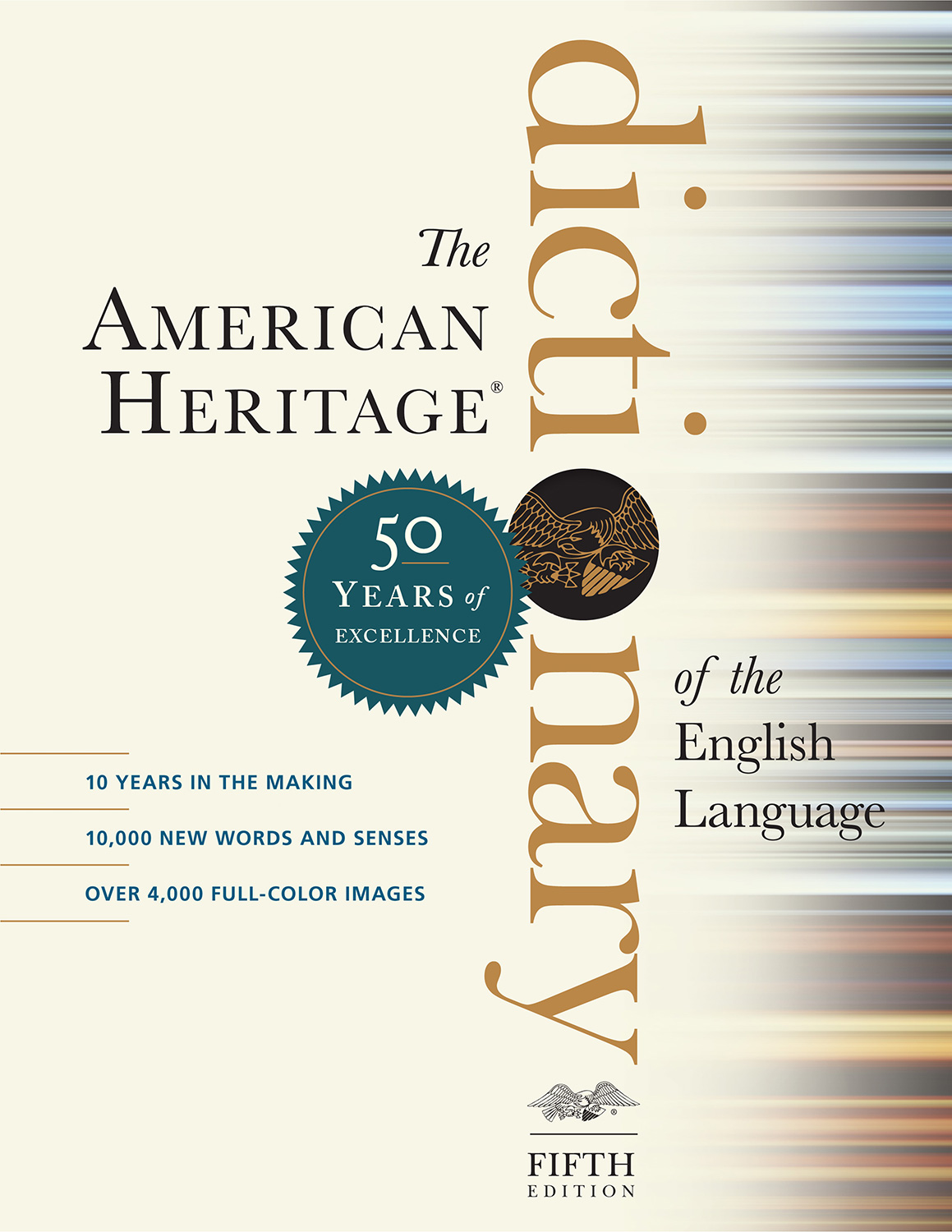
The American Heritage Dictionary of the English Language, Fifth Edition, is a record of English vocabulary as it is used by a broad and diverse group of educated speakers and writers. Its word list reflects the many complex elements that constitute our language. This guide explains how we have organized and presented the great array of information contained in the online dictionary and is intended to enable you to find and understand that information quickly and easily.
Superscript numbers
Unrelated words with identical spellings are entered separately and have superscript, or raised, numbers: tick1 (“A light, sharp, clicking sound”), tick2 (“A small bloodsucking arachnid”), tick3 (“A cloth case for a mattress or pillow”), etc.
Syllabication
An entry word and its derived forms are divided into syllables by dots: ac·e·tate. In entries such as ethyl acetate that consist of two or more words separated by spaces, the words without centered dots are divided into syllables at their own places in the dictionary. Pronunciations are syllabicated as well, for the sake of clarity. Sometimes the syllabication of the pronunciation differs from the syllabication of the entry word because the division of the pronunciation follows phonological rules, while the division of the entry word reflects the established practice of printers and editors in breaking words at the end of a line for ease of reading.
Pronunciation
To hear the pronunciation of the word spoken aloud, you can simply click on the speaker icon that appears immediately after the word at the beginning of the entry. The pronunciation is also represented by special symbols that are enclosed in parentheses and appear after the boldface entry word. If an entry word and a variant of that entry word share the same pronunciation, the pronunciation is shown immediately after the variant. If the pronunciation of the variant differs, pronunciations follow the forms to which they apply. If an entry or variant includes more than one pronunciation, subsequent pronunciations show only the syllables that are different in sound quality or stress from the first pronunciation or that are necessary for clarity. When multiple pronunciations are shown, the first is assumed to be the most common, but the difference in frequency may be insignificant.
A guide that explains how each symbol is pronounced can be found here.
Stress
The relative emphasis with which the syllables of a word or phrase are spoken, called stress, is indicated in three different ways. The strongest, or primary, stress is marked with a bold mark (). An intermediate, or secondary, level of stress is marked with a similar but lighter mark (′). The weakest stress is unmarked. Words of one syllable show no stress mark.
Variants
Written English in the United States is relatively standardized, but it nonetheless allows for many variant spellings and stylings. All variants shown in this dictionary are acceptable in any context unless a restrictive label, such as a dialect label, indicates otherwise. Variants appear in boldface and are of two kinds: equal and unequal.
- Equal variants The word or joining an entry word and its variant (on·line or on-line) indicates that these forms occur with roughly equal frequency in edited sources based on our electronic and printed citational evidence.
- Unequal variants The word also joining an entry word and its variant (am·bi·ance also am·bi·ence) indicates that the variant form occurs less frequently than the form given first.
Variants that are alphabetically very close to their entry words do not have their own entries entered in the online dictionary. All other variants are entered as cross-references:
 (mē′dē-ēvəl, mĕd′ē-, mĭ-dēvəl)
adj.
Variant of medieval.
(mē′dē-ēvəl, mĕd′ē-, mĭ-dēvəl)
(mē′dē-ēvəl, mĕd′ē-, mĭ-dēvəl)
adj.
Variant of medieval.
British variants
A number of variants consist of spellings preferred in the United Kingdom and in many former British colonies and territories other than the United States. These variants, such as defence and colour, are labeled Chiefly British. They have their own entries but are not listed at the American-English entries to which they relate. (Words that end with the suffix –ize, such as realize, are an exception to this rule. In most cases, this dictionary does not enter the British spelling ending in –ise at all.) When a word with a chiefly British variant occurs in compounds, the variant is not repeated at the compound. For example, the chiefly British variant colour is given for color but not for colorblind, color guard, and other such compounds.
Part-of-Speech Labels
The following italicized labels indicate parts of speech:
- adj. adjective
- adv. adverb
- conj. conjunction
- def.art. definite article
- indef.art. indefinite article
- interj. interjection
- n. noun
- prep. preposition
- pron. pronoun
- v. verb
The part-of-speech labels are supplemented as necessary by the following additional abbreviations:
- pl. plural
- sing. singular
- pl.n. plural noun
- tr. transitive
- intr. intransitive
- aux. auxiliary
- pref. prefix
- suff. suffix
- abbr. abbreviation
Certain entries, such as contractions, symbols, and trademarks, do not have part-of-speech labels.
Sometimes an entry word fulfills more than one grammatical function. For example, current can be an adjective (current pricing; current negotiations) and a noun (a current of air; the swift current of a river; electric current). In such cases the different parts of speech are defined within a single entry called a combined entry. The shift in grammatical function is indicated by the appropriate part-of-speech label. Syllabications and pronunciations that differ for these parts of speech are also included, along with any variant spellings. Inflected forms are given if necessary and are followed by definitions:
(rĭ-kôrd) (ĭk-skyz)
Inflections
Some entries include additional inflected forms of the word in question, such as principal parts of verbs (cap·i·tal·ize, -ized, -iz·ing, -iz·es), degrees of comparison of adjectives and adverbs formed by inflection (a·ble, a·bler, a·blest), and irregular plurals of nouns and plurals whose formation might cause a spelling problem (ra·di·us, -di·i, -di·us·es). These inflected forms are usually shortened to the last syllable of the entry word plus the inflectional ending.
Principal parts of verbs
The principal parts of verbs are listed in this order: past tense, past participle, present participle, and third person singular present tense. For example, fly1(flī) has the principal parts flew, flown, fly·ing, flies. When the past tense and the past participle are identical, only three principal parts are given.
Comparison of adjectives and adverbs
Adjectives and adverbs whose comparative and superlative degrees are formed by adding –er and –est to the unchanged word show these comparative and superlative suffixes immediately after the part-of-speech label:
(hī) adj.high·er, high·estIrregular comparative and superlative forms are given in full, as in bad, worse, worst.
Irregular plurals
Plurals of nouns other than those formed regularly by adding the suffixes –s or –es are shown and labeled pl.:
(mous) n., pl.mice(mīs).
When a noun has a regular and an irregular plural form, both forms appear:
(ə-kwârē-əm)
n. pl.a·quar·i·umsor a·quar·i·a (-ē-ə) Regular plurals are also shown when spelling might be a problem, as in the case of ra·di·o.
A noun that is chiefly or exclusively plural in both form and meaning, such as cat·tle, has the part-of-speech label pl.n. Nouns that are plural in form but sometimes or always take a singular verb, such as aer·o·bics and pol·i·tics, are labeled n. (used with a sing. or pl. verb) or n. (used with a sing. verb).
Separate entries for inflected forms
Inflected forms that are irregular are entered separately in the dictionary when they are not near the main entry word alphabetically. For instance, went (wĕnt) has its own entry where it is defined as the past tense of go1. Inflections that fall very close to the main word alphabetically, such as muddled, the past tense of mudd·le, are not given their own entries.
Labels
This dictionary uses various labels to identify entries that are part of the terminology of specific subjects and entries for which usage is limited to certain geographical areas. Other labels provide guidance regarding various levels of formality and usage.
- A subject label, such as Chemistry or Sports, identifies the special area of knowledge to which an entry word or a single definition applies.
- A status label, such as Nonstandard, Slang, Informal, Offensive, or Derogatory, indicates that an entry word or a definition is limited to a particular level or style of usage. All words and definitions not restricted by such a label should be regarded as appropriate for use in all standard or formal contexts.
- The label Usage Problem label warns of possible difficulties or controversies involving grammar, diction, or writing style. A word or definition so labeled is discussed in a Usage Note.
- The labels Archaic and Obsolete signal words or senses whose use in modern English is uncommon. Archaic words have not been in common use since at least the early 1900s except in self-consciously old-fashioned or poetic contexts. The label Obsolete is used for words and senses that have not been in common use since at least the mid-1700s.
- A regional or dialect label, such as Chiefly British or Upper Midwest, indicates that a particular entry word or sense is mostly limited to specific areas of the English-speaking world or to particular parts of the United States.
Cross-references
A cross-reference signals that additional information about one entry can be found at another entry. Cross-references have two main functions: to avoid needless duplication of information and to indicate where further discussion of a word occurs. The entry referred to in a cross-reference appears in boldface type preceded by a brief descriptive or instructional phrase:
(băd, bād) v. A past tense of bid. (fĕthər-ĕj′) n. . . . 2. See deckle edge. (krōnə) n., pl.-nor (-nôr′, -nər) See table at currency. Order of Senses
Entries containing more than one sense are arranged for the convenience of the reader with the central and often the most commonly sought meaning first. Senses and subsenses are grouped to show their relationships with each other. For example, in the entry at fatal, the commonly sought meaning “Causing or capable of causing death” appears first and the now obsolete sense “Having been destined; fated” comes last in the series of five.
Information such as regional labels or alternate pronunciations that apply only to a particular sense or subsense is shown after the number or letter of that sense or subsense.
Illustrative Examples
In this dictionary there are tens of thousands of illustrative examples that follow the definitions and show the entry word in typical contexts. These illustrative examples appear in italics; about 5,000 of them are quotations. The examples are taken from our files of electronic and printed citations showing patterns of word usage by a broad group of educated speakers in a wide array of publications. These examples are especially helpful in showing changing usage, attesting new words and meanings, illustrating transitive and intransitive verbs, and exemplifying levels and styles of usage.
Phrasal Verbs
A phrasal verb, such as make up or set about, is an expression consisting of a verb and an adverb or a preposition that together have a meaning that is different from the total of the meanings of its constituent parts. Phrasal verbs, which appear in boldface, follow the main definitions in an entry and are listed in alphabetical order.
Idioms
An idiom is an expression, such as kick the bucket or under a cloud, consisting of two or more words whose meaning cannot be deduced from the literal meanings of its words. Idioms, like phrasal verbs, are listed alphabetically in boldface and fully defined near the end of an entry. Idioms normally appear at the entry for the first important invariant word in the idiom—usually a verb or noun.
Undefined Forms
At the end of many entries additional closely related words appear in boldface without definitions. These words, usually formed from the entry words by the addition (or in some cases, the subtraction) of suffixes, involve the same basic meaning as the entry word but have different grammatical functions, as indicated by their part-of-speech labels. For instance, the entry at ex·cuse includes four undefined forms: —ex·cusa·ble adj., —ex·cusa·ble·ness n., —ex·cusa·bly adv., and —ex·cuser n.
Etymologies
Etymologies, appearing in square brackets following the definitions, trace the history of words as far back in time as can be determined with reasonable certainty. The stage most closely preceding Modern English is given first, with each earlier stage following in sequence:
(kăbĭn) n.1. A small, roughly built house; a cottage. . . . [Middle English caban, from Old French cabane, from Old Provençal cabana, from Late Latin capanna.] A language name, linguistic form, and brief definition or gloss of that form are given for each stage of the derivation. In order to avoid redundancy, however, a language, form, or gloss is not repeated if it is identical to the corresponding item in the immediately preceding stage. In the etymology shown for cabin, the different Middle English, Old French, and Late Latin forms all have the same gloss, which is the same as the first definition of the Modern English word cabin: “a small, roughly built house.”
Content of etymologies.
The etymologies in this dictionary are designed to be as readable as possible. Only parts of speech are abbreviated. The traditional language of descriptive grammar is used to identify parts of speech and various grammatical and morphological forms and processes, such as diminutive, frequentative, variant, stem, past participle, and metathesis. All of these terms are fully defined entries in the dictionary. Likewise, every language cited in an etymology is either a dictionary entry or is glossed in the etymology itself.
Sometimes a stage in the history of the word is not attested, yet there is reasonable certainty from comparative evidence about what the missing linguistic form looked like and what language it belonged to. These unattested forms are preceded by an asterisk indicating their hypothetical nature:
(sûrtn) adj.1. Definite; fixed: set aside a certain sum each week.2. Sure to come or happen; inevitable: certain success. . . . [Middle English, from Old French, from Vulgar Latin *certānus, from Latin certus, past participle of cernere, to determine. See krei- in App. I.] If a word is taken from the name of a person or place, the name is identified with pertinent information about time or place. The etymology usually stops there, although a further etymology of the name itself is occasionally given.
Some words are not given etymologies. These include compounds and derivatives formed in English from words or word elements that are entries in the dictionary, such as sodium chloride, emergence, and euploid. Derivatives such as emergence, from emerge, in which only the final vowel of one constituent has been deleted, are assumed to be sufficiently understandable not to need etymologies. All trademarks, as well as certain interjections and ethnic names that are Anglicizations of a group’s name for itself, also do not have etymologies.
Style of etymologies.
The etymologies present a great deal of complex information in a small space, and for this reason certain typographic and stylistic conventions are used. Linguistic forms that are not Modern English words appear in italics, and glosses and language names appear in roman type. When a compound word is split into its component elements in an etymology, a colon introduces them. Each element is traced in turn to its further origins. Parentheses enclose the further history of a part of a compound:
(s′dĭ-pĭgrə-fə) pl.n.1. Spurious writ¬ings, especially writings falsely attributed to biblical characters or times. 2. A body of texts written between 200 BC and AD 200 and spuriously ascribed to various prophets and kings of Hebrew Scriptures. [Greek, from neuter pl. ofpseudepigraphos, falsely ascribed : pseudēs, false; see PSEUDO- + epigraphein, to inscribe (epi-, epi- + graphein, to write; see gerbh- in Indo-European roots).] At times it is necessary to cross-refer from one etymology to another. This is done either to avoid repeating part of a lengthy and complex derivation or to indicate the close relationship between two different Modern English words. Words whose dictionary entries contain more etymological information are printed in small capitals in the etymologies:
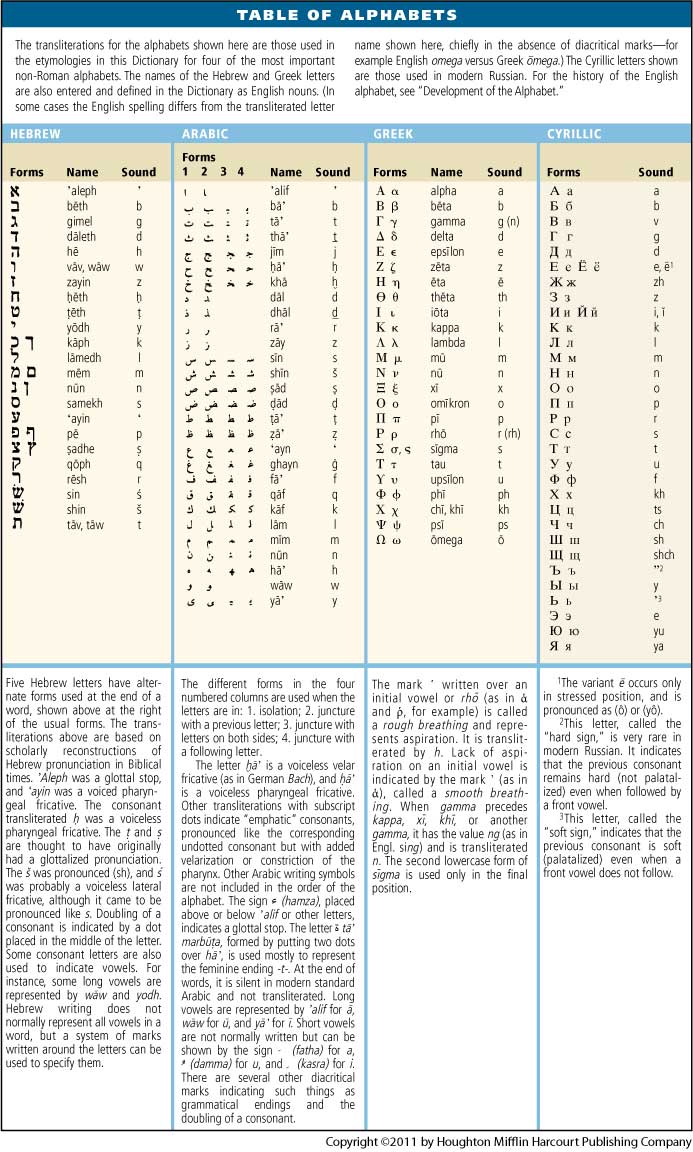
(băt) tr.v. bat·ted, bat·ting, bats To wink or flutter: bat one's eyelashes. Idiom: not bat an eye/eyelash Informal To show no emotion; appear unaffected: The reporter didn't bat an eyelash while reading the gruesome news. [Probably a variant of BATE2.]All languages mentioned in the etymologies are either entered and defined in the dictionary or described briefly in the etymology itself. The transliterations of Greek, Russian, Arabic, and Hebrew are as shown in the table at alphabet. Old English thorn (Þ) and edh (ð) are both given as th, whereas Old Norse thorn is spelled as th and the phonemically distinct edh as dh. In Latin and Greek, all long vowels are marked with macrons. The transcription of African and Native American languages occasionally requires the use of special symbols (usually drawn from the International Phonetic Alphabet) whose values will be apparent to specialists but are not discussed here. Mandarin Chinese forms are given in the Pinyin system. Cantonese forms are given according to the Jyutping system developed by the Linguistic Society of Hong Kong. Special symbols are also used in the etymologies of words of Chinese origin, which form one of the largest groups of words of non-Indo-European and non-Semitic origin in English. Many English words of Chinese origin are borrowings of Japanese, Korean, and Vietnamese words that were themselves borrowed from Chinese in medieval times, at the stage of the Chinese language known as Middle Chinese. The presentation of the pronunciation of Middle Chinese words, founded upon the work of the scholar Edmund Pulleyblank, uses the symbols of the International Phonetic Alphabet as well as other symbols particular to the study of the Sinitic languages.
Roots Appendices.
The great bulk of the vocabulary of English can be traced back to a reconstructed language called Proto-Indo-European, which is ancestral not only to English but to most languages of Europe and many of southwest and southern Asia. English words can be so traced either through their native origins in Old English or Proto-Germanic or through borrowings from other Indo-European languages (such as Greek, Latin, and the Romance languages). A sizable number of English words, however, are not of Indo-European origin, and most prominent and numerous among these are those borrowed from the Semitic languages, a family unrelated to Indo-European that includes Hebrew and Arabic. Scholars have been able to reconstruct Proto-Semitic, the common ancestor of the Semitic languages, in much the same way they have reconstructed Proto-Indo-European. If an English word is ultimately derived from a reconstructed Proto-Indo-European or Proto-Semitic root, the etymology in the dictionary traces the word back to its earliest documentary attestation, then refers the reader to an entry in the Appendix of Indo-European Roots (Appendix I) or the Appendix of Semitic Roots (Appendix II) at the end of the print version of the dictionary. Each appendix, arranged by root, provides further information on the reconstructed prehistory of the word back to the earliest stage ascertainable by comparative linguistics.
Notes
This dictionary contains four types of notes: Synonym Paragraphs, Usage Notes, Word Histories, and Our Living Language Notes. An explanation of each type follows.
Synonym Paragraphs.
Synonyms of special interest are listed after the entry for the central word in the group. Synonym paragraphs are introduced by the heading Synonyms. There are two kinds of synonym paragraphs. The first consists of a group of undiscriminated, alphabetically ordered words sharing a single, irreducible meaning. These synonyms are presented in illustrative examples following a core definition. Antonyms often appear at the end of the paragraph. An example of an undiscriminated synonym paragraph appears at the entry for plentiful.
The second kind of paragraph consists of fully discriminated synonyms ordered in a way that reflects their interrelationships. A brief sentence explaining the initial point of comparison of the words is given, followed by explanations of their connotations and varying shades of meaning, along with illustrative examples. An example of a discriminated synonym paragraph appears at the entry for real1.
Every synonym in a synonym paragraph is cross-referenced to that synonym paragraph. Sometimes a word is discussed in more than one synonym paragraph. Cross-references are given to all the synonym paragraphs that include this word.
Usage Notes.
The Usage Notes following many entries present important information and guidance on matters of grammar, diction, pronunciation, and registers and nuances of usage. For a detailed discussion of usage and our Usage Panel, see Steven Pinker’s essay “Usage in The American Heritage Dictionary” on pages xvi-xix in the print version of the dictionary.
Many notes, such as those at epicenter and factoid, contain opinions of the Usage Panel about the acceptability or conventionality of words, especially as used in formal standard English contexts. Others, such as those at criterion and principal, are more explanatory in nature and do not refer to Panel opinions. Entries of words discussed in the notes have cross-references to the entry at which the note appears. If an entry that has a note is discussed in a note at another entry, the cross-reference to that entry is given immediately following the Usage Note.
Word Histories.
In addition to etymologies, which necessarily contain information in a compressed form, this dictionary provides Word History paragraphs at entries whose etymologies are of particular interest. In these notes, the bare facts of the etymology are expanded to give a fuller understanding of how important linguistic processes operate, how words move from one language to another, and how the history of an individual word can be related to historical and cultural developments. For example, the Word History for sacrum discusses how the word comes from a Latin phrase meaning “holy bone.” The note also explains how the Romans acquired the idea that the sacrum was sacred from the Greeks and how the notion of the bone’s sacredness arose among the Greeks.
Our Living Language Notes.
Language varies both by region and social group, and this dictionary contains notes that discuss these aspects of words. Some of these words and constructions fall outside standard usage. But most are widely recognized for their cultural importance and for their expressivity, and some have been incorporated into the standard language. For a discussion of social variation in English, see John R. Rickford’s essay “Variation and Change in Our Living Language” on pages xiii-xv in the print version of the dictionary.
Some notes discuss regional words, words used chiefly in a single area or region of the United States. For example, the word dragonfly is widespread in American English, but there are many dialect terms for the insect as well. These terms are listed at the entry for dragonfly and discussed in the note at the end of the entry. Other notes, such as those at be and zero copula, explain the patterns of usage of particular constructions and describe the linguistic situations under which they are and are not used, in order to show how they fit into the broader phenomenon of language. Still other notes, such as those at comparative and mine2, explain the linguistic processes governing certain constructions that might at first appear to be errors or anomalies, relating such constructions to similar examples in earlier times and showing them to have traveled a different path from their standard counterparts for centuries. Still other notes, such as those at cool, and schlock describe groups of words that have arisen from the lingo of particular subcultures, such as jazz musicians or speakers of Yiddish.